Long-Range Autonomous Drone Exploration and Return Technology in GPS-Denied Environments through UWB Anchor and VIO Fusion
NEXT Foam has researched and developed autonomous navigation technology that enables drones to independently enter, explore, and return to their starting point in confined environments such as caves and tunnels where GPS and pre-built maps are unavailable.
This technology enables a drone to autonomously deploy UWB ranging anchors at regular intervals during flight and fuse UWB distance measurements with VIO (Visual-Inertial Odometry), which uses cameras and an IMU, to correct accumulated positioning errors during long-distance missions. The anchor positions are also estimated simultaneously using EKF-SLAM, enabling stable return navigation even in GPS-denied environments.
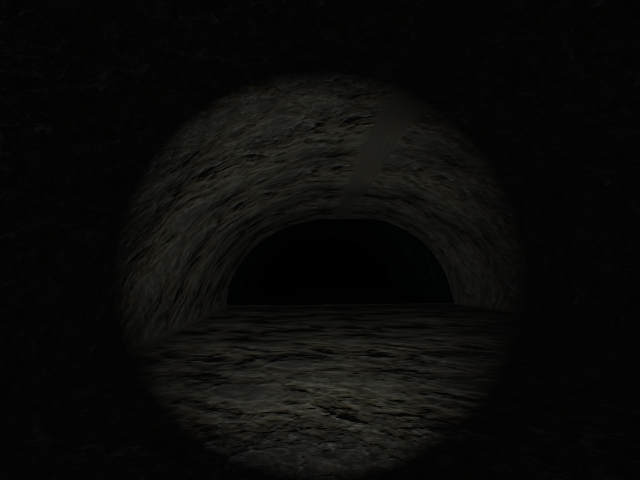
<A simulated Martian cave environment without natural lighting>
In large-scale offline validation using actual flight data, NEXT Foam confirmed that integrating UWB anchors reduced the return endpoint error from approximately 108 m with VIO alone to approximately 0.9–1.5 m. We also verified that a wall-to-wall weaving trajectory, which provides greater lateral observability than straight-line flight, significantly improves navigation accuracy.
<Visual navigation using illumination mounted on the drone>
NEXT Foam subsequently validated the technology in a closed-loop flight environment based on ArduPilot SITL and Gazebo, where the actual controller, estimator, and flight path interact with one another.
During this process, we analyzed issues including divergence in position-based steering, lateral oscillation, and propagation of anchor-position bias. Stability was improved by applying estimator-based steering, PD control, anchor initialization and uncertainty correction, and a weaving-path strategy.
Ultimately, the drone successfully completed a 120 m weaving course three consecutive times and achieved its first successful full mission on a 250 m one-way, approximately 520 m round-trip course.
During this flight, the mission was completed without contact with the tunnel walls, and a return endpoint error of just 0.19 m was achieved.
Through these results, NEXT Foam has progressively demonstrated the feasibility of long-range autonomous exploration and return navigation technology in GPS-denied environments.
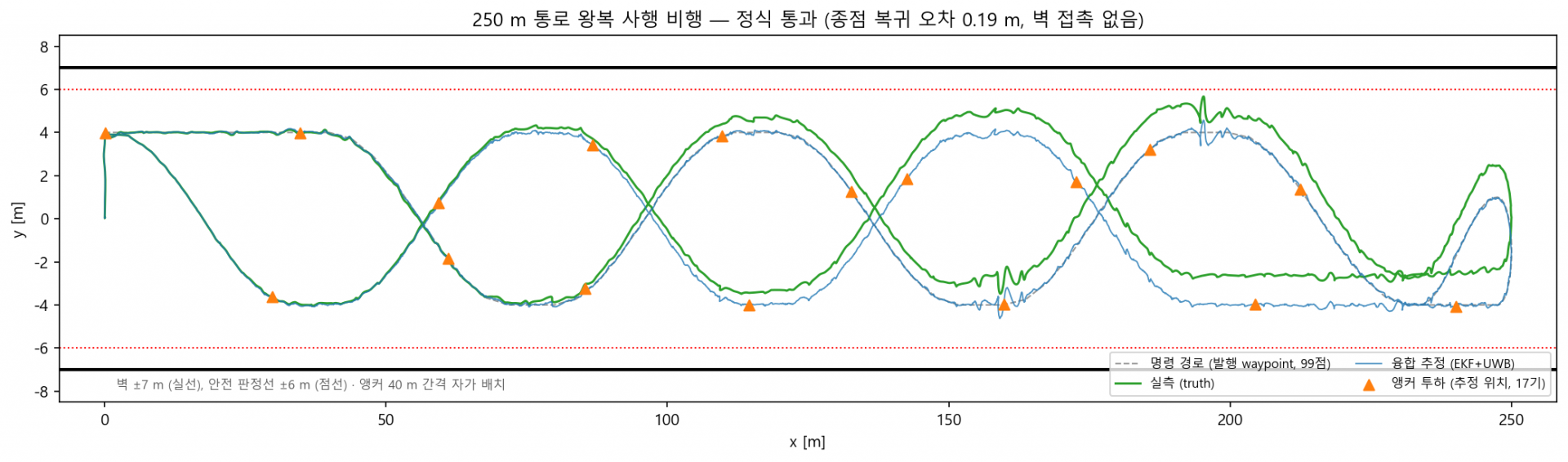
<Round-trip flight through a long cave while minimizing drift by deploying pseudo-satellites (red triangles)>
Going forward, NEXT Foam plans to build on the navigation and control technologies developed to date by applying them to real drone hardware and expanding their use to a wider range of passageways and unstructured environments.
We appreciate your interest and support!





Long-Range Autonomous Drone Exploration and Return Technology in GPS-Denied Environments through UWB Anchor and VIO Fusion
NEXT Foam has researched and developed autonomous navigation technology that enables drones to independently enter, explore, and return to their starting point in confined environments such as caves and tunnels where GPS and pre-built maps are unavailable.
This technology enables a drone to autonomously deploy UWB ranging anchors at regular intervals during flight and fuse UWB distance measurements with VIO (Visual-Inertial Odometry), which uses cameras and an IMU, to correct accumulated positioning errors during long-distance missions. The anchor positions are also estimated simultaneously using EKF-SLAM, enabling stable return navigation even in GPS-denied environments.
<A simulated Martian cave environment without natural lighting>
In large-scale offline validation using actual flight data, NEXT Foam confirmed that integrating UWB anchors reduced the return endpoint error from approximately 108 m with VIO alone to approximately 0.9–1.5 m. We also verified that a wall-to-wall weaving trajectory, which provides greater lateral observability than straight-line flight, significantly improves navigation accuracy.
<Visual navigation using illumination mounted on the drone>
NEXT Foam subsequently validated the technology in a closed-loop flight environment based on ArduPilot SITL and Gazebo, where the actual controller, estimator, and flight path interact with one another.
During this process, we analyzed issues including divergence in position-based steering, lateral oscillation, and propagation of anchor-position bias. Stability was improved by applying estimator-based steering, PD control, anchor initialization and uncertainty correction, and a weaving-path strategy.
Ultimately, the drone successfully completed a 120 m weaving course three consecutive times and achieved its first successful full mission on a 250 m one-way, approximately 520 m round-trip course.
During this flight, the mission was completed without contact with the tunnel walls, and a return endpoint error of just 0.19 m was achieved.
Through these results, NEXT Foam has progressively demonstrated the feasibility of long-range autonomous exploration and return navigation technology in GPS-denied environments.
<Round-trip flight through a long cave while minimizing drift by deploying pseudo-satellites (red triangles)>
Going forward, NEXT Foam plans to build on the navigation and control technologies developed to date by applying them to real drone hardware and expanding their use to a wider range of passageways and unstructured environments.
We appreciate your interest and support!